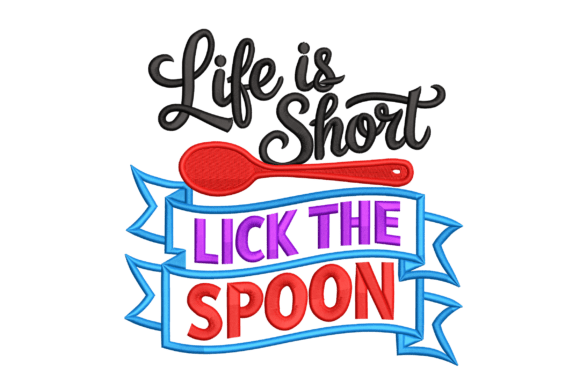
Life Is Short Lick the Spoon
Every designer I know has a soft spot for kitchen-themed embroidery that manages to feel personal without being precious. Life is Short Lick the Spoon does exactly that. It lands in that sweet spot between cheeky and sentimental, and that is harder to pull off than most embroidery designs will admit. When I first opened this machine embroidery design file, I immediately thought of the aprons and tea towels that actually sell at markets, not the ones that sit on a booth table being politely ignored. This design has a voice. It makes you smile, and more importantly, it makes the person who buys your finished product smile every time they reach for a spoon.
What This Design Communicates Before a Single Stitch
The visual personality of Life is Short Lick the Spoon is warm, slightly mischievous, and completely approachable. The lettering carries a modern hand-drawn feel, not something stiff or overly perfect. That matters in embroidery because a design that looks too rigid on screen often feels cold once it is stitched onto fabric. This one avoids that trap. The layout is clean without being boring, and the overall composition respects the space it occupies. It does not try to fill every corner. It breathes. That kind of restraint is what separates a professional embroidery file from something that looks like it was thrown together in five minutes.
The mood here is perfect for kitchen and cooking projects, but I would not limit it to strictly functional items. The tone works just as well on a personalized gift for a baker friend or as part of a boutique product line aimed at people who love to cook but do not take themselves too seriously. It is the kind of design that makes a finished product feel like it was made for someone specific, not mass-produced for anyone with a credit card.
Where Life is Short Lick the Spoon Performs Best
After stitching this design on several different blanks, I can tell you where it truly shines and where you should think twice before committing thread to fabric. The natural home for this design is aprons, hands down. A crisp canvas or cotton twill apron with this embroidery centered on the chest panel becomes an immediate conversation starter. It is also outstanding on tea towels, especially if you are building a coordinated set for a kitchen gift bundle. The size and layout work well on a standard tea towel when placed about a third of the way down from the hem.
I tested it on a tote bag as well, and that is where I saw the strongest commercial potential. Tote bags are a staple for any small shop or craft business, and this design gives customers a reason to choose your bag over a plain one. The stitch-out was clean on medium-weight cotton and on a quality blended canvas. If you are an Etsy seller looking to add a new item to your shop that requires minimal production time but delivers maximum visual impact, this design is worth putting into rotation.
For sweatshirt embroidery, I recommend a medium hoop and a tear-away stabilizer with a light cut-away layer underneath if the fabric has any stretch. The design held up well on a cozy French terry pullover, and the lettering remained crisp even after a gentle wash cycle. I would also consider this for custom apparel like chef coats or catering uniforms, where a subtle but memorable detail can make a brand feel more human.
Building a Real Project Around This Design
Let me walk you through a real project I prepared using Life is Short Lick the Spoon. A friend runs a small baking business out of her home, and she wanted aprons to sell alongside her cookies at the local farmers market. She needed something that felt handmade but not sloppy, personal but not cutesy. I pulled up this design and knew it was the right fit.
I chose a light cream cotton apron with a mid-weight feel. The thread color I landed on was a deep espresso brown, which gave the lettering a warm, readable contrast against the cream without screaming for attention. The stitch-out took roughly ten minutes per apron, and I was able to produce a small batch of eight in one afternoon. The final product looked like something you would find at a boutique kitchen supply shop, not a flea market table. My friend sold out of those aprons in two weekends. That is the kind of result that makes a designer trust a file enough to use it again.
The design was straightforward to load into the machine, and the stitch path was logical. The machine did not jump around unnecessarily, and I noticed no thread breaks during production. For anyone running a commercial embroidery operation, efficiency matters, and this design does not waste your time.
Technical Details That Matter During Stitching
Before you commit thread, there are a few things to confirm on your end. The design uses a combination of satin stitch for the main lettering and some lighter fill stitch areas that give the letters a bit of depth. The stitch density felt appropriate for most medium-weight fabrics, but I would recommend testing on an identical fabric scrap before stitching on your final product. Thread color choice makes a significant difference here. A dark thread on a dark background will kill the readability of the design entirely. Test it in black and white first to check contrast before you load your machine.
Hoop size is something you need to verify with your specific embroidery file. Make sure your hoop is large enough that the design sits comfortably in the center of the stitching field. Crowding the edges of a hoop can cause distortion, especially on fabrics that have any natural stretch. If you are stitching on a curved surface like a cap or a small pouch, pay extra attention to how the design sits. Flat surfaces are this design's best friend. Curved surfaces can work, but you will want to stabilize carefully and test before you produce for a client.
Where to Exercise Caution
No design is perfect for every application, and Life is Short Lick the Spoon has its limits. I would avoid using this on thin fabric like lightweight rayon or delicate silk. The stitch density, while reasonable, can cause puckering on fabrics that lack body. Similarly, stretchy fabric like thin jersey knit can distort the lettering if you do not use a proper stabilizer. A cut-away stabilizer is your best bet for knits. Do not skip a test stitch on the exact fabric you plan to use.
For dark fabric backgrounds, consider using a lighter thread color or a subtle metallic if you want a bit of shine. The design can get lost on black or navy if you use a dark gray or a muted brown. Test a small section before committing to a full run. Small hoop sizes may also be a challenge if your hoop is barely larger than the design. The design needs breathing room around the edges for the fabric to lay flat during stitching.
If you are producing handmade products that will be washed frequently, like tea towels or aprons, I recommend preshrinking your fabric and using a high-quality polyester or rayon thread that can hold up to regular laundering. The design itself is sturdy, but the longevity of your finished product depends on your materials as much as the embroidery file.
Commercial Use and Business Value
For small business owners, Etsy sellers, and anyone running a craft business, this design has solid commercial appeal. It is the kind of design that photographs well for printable mockups and digital product previews. When I created mockups for my own shop listing, the design read clearly even at thumbnail size, which is important for online sales. Customers scrolling through search results need to understand what they are looking at in under two seconds, and this design delivers that clarity.
If you sell finished products at craft fairs or through a boutique, this design gives you something that feels current but not trendy. Trendy designs fade. Designs with personality endure. This one has staying power because it speaks to a universal experience: the simple joy of baking and not being overly precious about it. That resonates with a wide customer base, from young home bakers to grandparents who have been making pies for fifty years.
Before you sell any finished items or include this design in a digital product bundle, confirm the licensing terms that came with your embroidery file. Different designers and distributors have different rules. Some allow unlimited commercial use of finished products. Others require attribution or have caps on production volume. Read the fine print, keep a record of your license, and respect the creator's terms. That is how the embroidery community stays healthy and fair.
Final Designer Notes Before You Stitch
Test on scrap fabric first. I cannot say that enough. Every fabric behaves differently, and the same design can look amazing on one material and mediocre on another. Check your thread color contrast under natural light and under artificial light. Compare how the design looks on a light fabric and a dark fabric. Use a proper stabilizer for your fabric type. If you are unsure, test with both a tear-away and a cut-away and see which produces a cleaner result.
Review the stitch density before you start. If the design feels too dense for your fabric, you can sometimes adjust the density in your embroidery software, but do not alter the design so much that you lose its character. Pay attention to the small details in the lettering. Make sure the needles are sharp and the thread tension is balanced. A slight tension issue can turn clean satin stitching into something ragged, and that will cheapen even the best design.
For digital embroidery file use, I always recommend keeping a backup of the original file and working from a copy. If you make adjustments for a specific project, save those adjustments separately so you can return to the original later. This is especially important if you are selling design assets or using the design across multiple client projects.
At the end of the day, Life is Short Lick the Spoon is a design that respects your time, your materials, and your customer's sense of humor. It stitches cleanly, it photographs well, and it makes people feel something good when they see it. That is the kind of embroidery project you come back to again and again. Whether you are making a personalized gift for a friend, building an inventory for a shop, or testing a new direction for your handmade product line, this design earns its place in your digital collection.